Google is Paying to Build AI Agents
Google is investing heavily in AI agent infrastructure. Here is what that means for builders.
Google is investing heavily in AI agent infrastructure. Here is what that means for builders.
Free resources that teach AI better than most paid courses. Save your money.
Claude usage analytics tool breakdown — track tokens, costs, and optimize your AI spend.
MCP connector from Higgsfield enables mass ad creative generation with AI agents.


Another ChatGPT trend is here People are turning their profiles into cute crayon-style cartoons using ChatGPT. The idea is simple. Upload a screenshot of your profile, paste the prompt, and let the model redraw the whole page as if it was made with crayons on white paper. The result keeps the profile layout, but turns the details into a playful handmade version filled with sweet childlike elements. It works because the output feels personal, nostalgic, and instantly shareable. Would you try this with your own profile?

MIT Technology Review's daily newsletter highlights growing divisions within the Trump White House over Chinese AI models, with current and former advisers publicly clashing on policy direction. A second story covers a record-setting copyright payout. The item provides a brief overview rather than in-depth analysis of either topic.
See more
The US government attempted to blacklist Anthropic after the company refused Pentagon demands for unrestricted Claude access, including potential lethal targeting. A federal judge blocked the ban as likely First Amendment retaliation. The dispute reveals a structural problem: serious AI governance arguments only happen inside frontier labs, creating a form of regulatory capture that predates regulation itself.
See more
A VentureBeat survey of 157 enterprises reveals a critical agent evaluation gap: 50% have shipped AI agents that passed internal evaluations but then failed in production, and only 5% fully trust automated evaluation today. Despite this, 66% already allow or are engineering toward zero-human-in-the-loop deployment for low-risk agents. The core problem is not evaluation coverage but reality alignment — evaluations pass agents that fail real customers, and autonomy is scaling faster than assurance.
See more
A Chinese open-weight model triggered the worst week for chip stocks since April as investors questioned what $725B in AI capex is actually buying. Separately, an autonomous agent breached Hugging Face, and US frontier-model guardrails locked out defenders who then ran forensics on an open Chinese model. Washington simultaneously moved to restrict access to closed models, making open-weight the common winner across both market and security fronts.
See more
US Treasury Secretary Scott Bessent told Fox Business that American LLM 'watermarks' have been detected on Chinese AI models, implying unauthorized use of US-developed models. He called the situation unacceptable and indicated the US government will examine the issue in the coming days. The remarks signal potential escalation in US-China AI intellectual property enforcement.
See more
Aon reports that North American deal values rose 73% between 2024 and 2025, driving increased demand for transactional risk insurance. In 2025, clients recovered over $1 billion across transaction solutions claims, with median reps and warranties payments hitting a record $8.2 million. Financial statements claims account for 38% of paid losses, with improper revenue recognition the single greatest driver, highlighting the difficulty of detecting risks during diligence.
See more
RouteCost is a multi-stage ML framework for pre-order shipping cost estimation in e-commerce, decomposing the problem into demand forecasting, baseline pricing, residual correction, and box-consolidation inference. Tested on 250,000+ orders and 260 products over 18 months, it improves predictive quality and calibration while preserving route-level interpretability. The approach addresses limitations of static lookup tables and monolithic regressors that miss operational effects like shipment consolidation.
See more
Forrester analyst takes over coverage of the Product Information Management (PIM) space and observes that AI is rapidly transforming it beyond its traditional roots. The post reflects on vendor briefings, historical research, and the evolution of PIM systems. However, the visible body is truncated and lacks substantive detail on specific AI-driven changes or vendor assessments.
See more
Two Chinese AI companies released models claiming to rival OpenAI and Anthropic, triggering market volatility and familiar geopolitical alarm. The article argues the US should stop being surprised by Chinese AI progress and treat it as an expected development. It critiques the repetitive cycle of shock headlines and arms-race rhetoric.
See more
Over the past nine months, Amazon, Microsoft, and Google have each launched or rebranded enterprise agent platforms that are converging on a shared architectural pattern. This trend signals a maturing market where multi-agent orchestration, tool integration, and enterprise guardrails become standard. Leaders evaluating agent platforms should watch this convergence as a sign of emerging industry standards.
See more
MIT Technology Review highlights how advanced materials science is the foundational layer enabling next-generation AI progress. While most AI discourse focuses on algorithms, compute, and fab investments, materials innovation drives improvements in processing power, memory, and energy efficiency. The article argues this underappreciated layer is critical to sustaining AI's trajectory.
See more
IBM announced preliminary results that rattled the software market, but the real story is IBM-specific. Ben Thompson examines IBM's mainframe franchise as its core moat and the company's many AI-related problems. The piece frames IBM's struggles as a convergence of legacy dependency and AI strategy failures.
See more
A TLDR newsletter roundup covering three AI-related stories: a deal between Meta and Anthropic, SpaceX providing compute infrastructure to the Pentagon, and AI-assisted code migrations. The post body was unavailable, so detailed analysis is limited. The topics span enterprise AI partnerships, defense-sector compute provisioning, and developer tooling for legacy code modernization.
See more
Google released three new Gemini models—3.6 Flash, 3.5 Flash-Lite, and Flash Cyber—expanding its portfolio of efficient and specialized AI models. However, the continued absence of Gemini 3.5 Pro raises questions about Google's flagship AI strategy and whether the company is prioritizing breadth over a top-tier reasoning model.
See more
Marginal Revolution comments on China's AI strategy of commoditizing complements, noting that Xi explicitly ties AI openness to moving from digital into physical applications. China's dominance in robotics and manufacturing stands to benefit massively from widely available AI models. The post is a brief strategic observation rather than a detailed analysis.
See more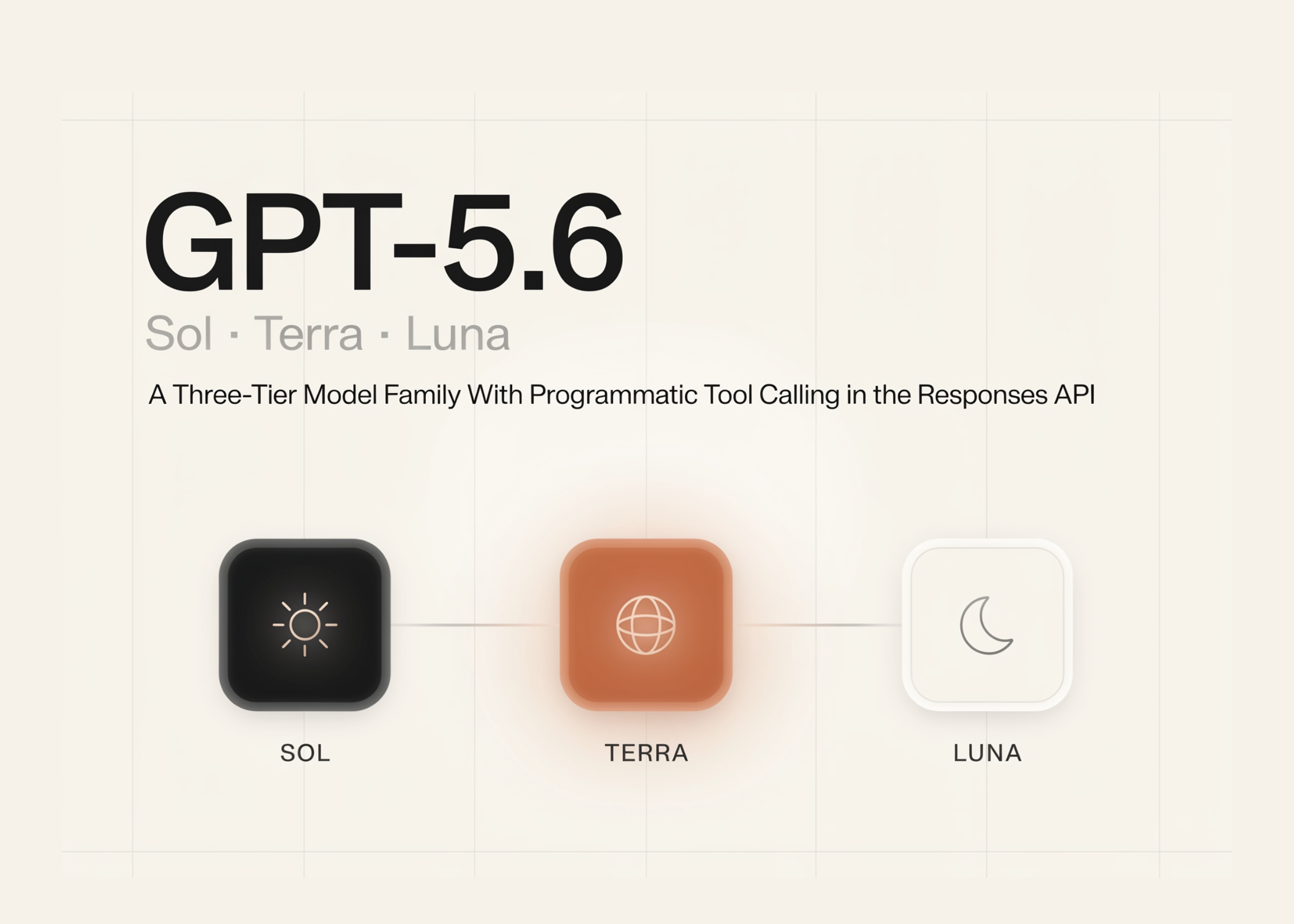
OpenAI released GPT-5.6 in three tiers (Sol, Terra, Luna) with Programmatic Tool Calling—a feature that runs model-generated JavaScript in isolated V8 to orchestrate tools directly, reducing prompt token usage by 38-63% versus traditional approaches. Sol achieves 80 on the Artificial Analysis Coding Agent Index and 62.6% on OSWorld 2.0 benchmarks. While Claude Fable 5 leads in overall intelligence metrics, GPT-5.6's tool automation architecture significantly improves efficiency for agent-based applications.
See more
Business Insider is shifting away from aggregation toward original beat reporting where journalists own their beats end-to-end. Editor-in-chief Jamie Heller describes a model where reporters do features, spot stories, and everything in between rather than specializing. The piece offers an inside look at BI's editorial strategy and Tuesday morning news meetings at their New York headquarters.
See more
Freight demand is bifurcating: consumer sectors like beverages and appliances are struggling while industrial demand for electrical goods, data centers, and batteries soars. Dr. Jason Miller of Michigan State University warns the AI data center build-out could be an 'absolute bubble' resembling past tech booms, with significant implications for freight market planning.
See more
Savills India reports that new data centre capacity additions in India reached 258 MW IT in H1 2026, up from 162 MW IT in H1 2025 — a 59% year-on-year increase. The growth signals strong demand for digital infrastructure driven by cloud adoption and AI workloads. This is a brief news item with limited analysis beyond the headline figures.
See more
AI has commoditized routine ghostwriting, reducing demand at the lower end of the market. Surviving agencies are pivoting away from volume-based word production toward selling authenticity and human judgment. The piece frames this as a broader shift in how content services are valued in the AI era.
See more