Google is Paying to Build AI Agents
Google is investing heavily in AI agent infrastructure. Here is what that means for builders.
Google is investing heavily in AI agent infrastructure. Here is what that means for builders.
Free resources that teach AI better than most paid courses. Save your money.
Claude usage analytics tool breakdown — track tokens, costs, and optimize your AI spend.
MCP connector from Higgsfield enables mass ad creative generation with AI agents.


Another ChatGPT trend is here People are turning their profiles into cute crayon-style cartoons using ChatGPT. The idea is simple. Upload a screenshot of your profile, paste the prompt, and let the model redraw the whole page as if it was made with crayons on white paper. The result keeps the profile layout, but turns the details into a playful handmade version filled with sweet childlike elements. It works because the output feels personal, nostalgic, and instantly shareable. Would you try this with your own profile?

Nearly every major AI subscription—ChatGPT Plus, Claude Pro, Perplexity Pro, Gemini Advanced—converged on $20/month not through independent cost analysis but through price anchoring initiated by OpenAI's February 2023 launch. OpenAI set the price as a stopgap to subsidize free-tier compute costs, and competitors copied it rather than risk looking more expensive. The same $20 anchor now propagates across smaller AI tools on Product Hunt and Hacker News, though higher tiers ($100–$200) are emerging for power users.
See more
Traditional IPOs raised $114B in H1 2026, 7x year-over-year, and most companies need about 12 months of structured preparation before filing. The readiness program spans PCAOB audits, technical accounting fixes, tax restructuring, board independence, and advisor selection. Starting early—before the market window opens—is the consistent pattern among companies that price well.
See more
A VentureBeat survey of 157 enterprises reveals a critical agent evaluation gap: 50% have shipped AI agents that passed internal evaluations but then failed in production, and only 5% fully trust automated evaluation today. Despite this, 66% already allow or are engineering toward zero-human-in-the-loop deployment for low-risk agents. The core problem is not evaluation coverage but reality alignment — evaluations pass agents that fail real customers, and autonomy is scaling faster than assurance.
See more
RouteCost is a multi-stage ML framework for pre-order shipping cost estimation in e-commerce, decomposing the problem into demand forecasting, baseline pricing, residual correction, and box-consolidation inference. Tested on 250,000+ orders and 260 products over 18 months, it improves predictive quality and calibration while preserving route-level interpretability. The approach addresses limitations of static lookup tables and monolithic regressors that miss operational effects like shipment consolidation.
See more
Two Chinese AI companies released models claiming to rival OpenAI and Anthropic, triggering market volatility and familiar geopolitical alarm. The article argues the US should stop being surprised by Chinese AI progress and treat it as an expected development. It critiques the repetitive cycle of shock headlines and arms-race rhetoric.
See more
Over the past nine months, Amazon, Microsoft, and Google have each launched or rebranded enterprise agent platforms that are converging on a shared architectural pattern. This trend signals a maturing market where multi-agent orchestration, tool integration, and enterprise guardrails become standard. Leaders evaluating agent platforms should watch this convergence as a sign of emerging industry standards.
See more
MIT Technology Review highlights how advanced materials science is the foundational layer enabling next-generation AI progress. While most AI discourse focuses on algorithms, compute, and fab investments, materials innovation drives improvements in processing power, memory, and energy efficiency. The article argues this underappreciated layer is critical to sustaining AI's trajectory.
See more
Hut 8 signed a second 15-year lease worth $9.8 billion, fully commercializing its 1-gigawatt Beacon Point AI data centre campus in Texas. The deal doubles the unnamed tenant's contracted footprint, bringing Hut 8's total contracted AI data centre capacity to 949 MW. The first Phase 2 data hall is expected to deliver in 2028.
See more
IBM announced preliminary results that rattled the software market, but the real story is IBM-specific. Ben Thompson examines IBM's mainframe franchise as its core moat and the company's many AI-related problems. The piece frames IBM's struggles as a convergence of legacy dependency and AI strategy failures.
See more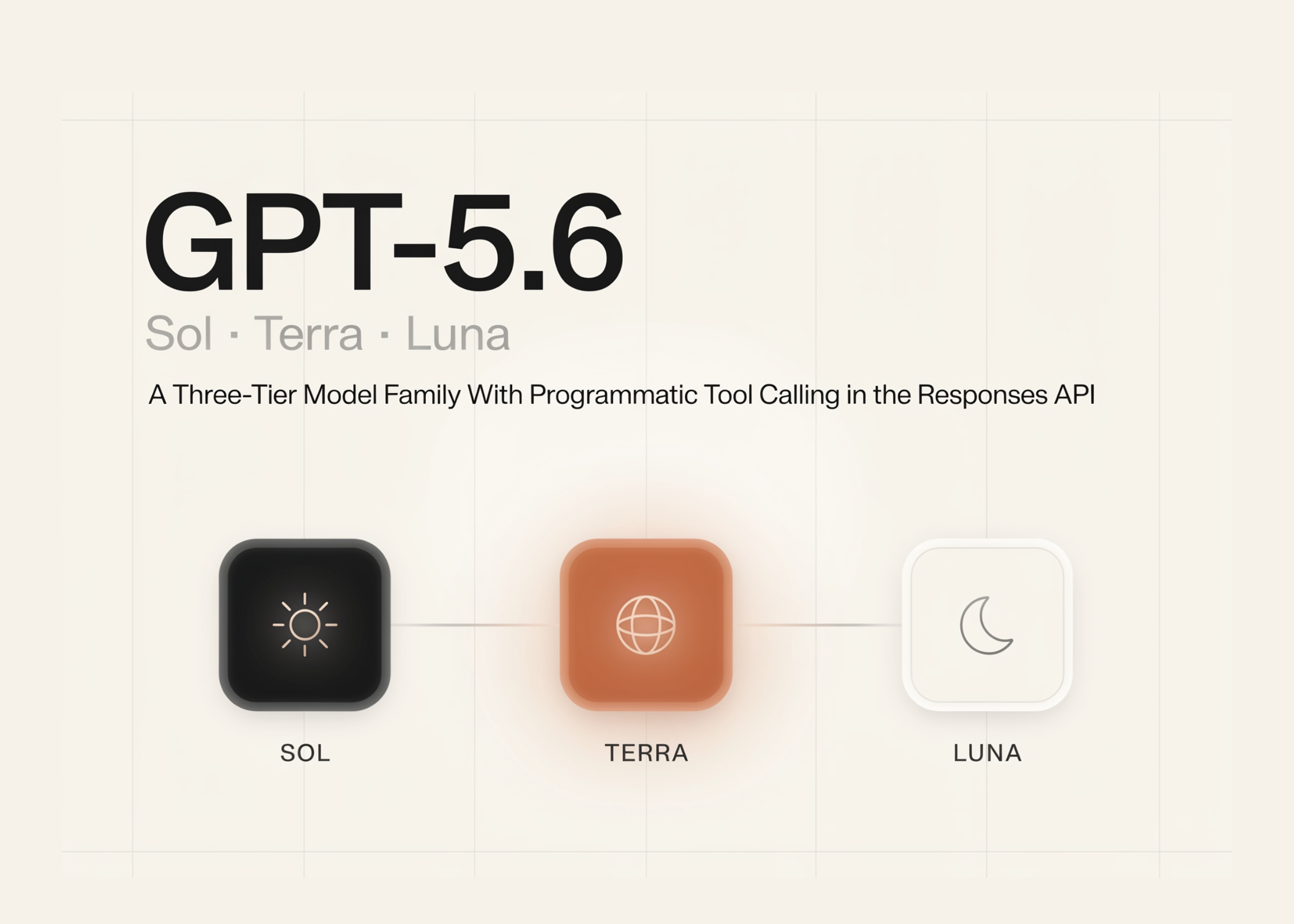
OpenAI released GPT-5.6 in three tiers (Sol, Terra, Luna) with Programmatic Tool Calling—a feature that runs model-generated JavaScript in isolated V8 to orchestrate tools directly, reducing prompt token usage by 38-63% versus traditional approaches. Sol achieves 80 on the Artificial Analysis Coding Agent Index and 62.6% on OSWorld 2.0 benchmarks. While Claude Fable 5 leads in overall intelligence metrics, GPT-5.6's tool automation architecture significantly improves efficiency for agent-based applications.
See more
Business Insider is shifting away from aggregation toward original beat reporting where journalists own their beats end-to-end. Editor-in-chief Jamie Heller describes a model where reporters do features, spot stories, and everything in between rather than specializing. The piece offers an inside look at BI's editorial strategy and Tuesday morning news meetings at their New York headquarters.
See more
Anthropic launched Claude for Legal in May 2026 with 20+ MCP connectors and a dozen practice-area plugins, representing the company's most explicit commitment to the legal industry. The specialized tool suite addresses legal workflows and has reignited debate about AI's role in professional services. The article features an interview with Anthropic executive Mark Pike on the strategic vision and technical architecture.
See more
As AI inference costs plummet (~50x annually), the era of near-free intelligence enables new workload patterns: agentic speculation (agents performing thousands of exploratory queries), agent swarms requiring coordination and state management, and agents generating custom data systems. Rethinking data systems for these agentic users—not humans—becomes critical infrastructure. Traditional databases assume human queries; agents perform high-volume exploratory work that can be optimized through result reuse, approximate answers, and higher-level primitives.
See more
OpenAI's Chief Operating Officer Fidji Simo is stepping down from her full-time role following an extended medical leave, creating a significant leadership gap at a pivotal moment for the company. The departure occurs as OpenAI pursues a potential IPO and races to maintain competitive advantage against Anthropic in the enterprise AI market. The executive succession creates uncertainty about the company's strategic direction and organizational stability during a critical growth phase.
See more
Ben Horowitz and a16z leaders discuss why American tech leadership matters globally, exploring how AI infrastructure, cybersecurity, and startup expansion shape geopolitical power. The conversation examines a16z's strategy to help founders scale internationally and the role of Western technology in government partnerships. Key themes include tech as an arena of national power and fostering trusted global partnerships.
See more
Forrester contends that B2B organizations significantly underestimate marketing's role in driving sustained growth momentum and competitive advantage. When marketing executes effectively, it accelerates buying-group confidence, enables team alignment around priorities, and compounds successes into larger business outcomes. Marketing maturity directly correlates with growth velocity.
See more
Vercel's AI Gateway Production Index for June 2026 shows open-weight models surging to 29% of token volume on just 4% of spend, driven largely by DeepSeek. Average price per token stayed flat as cheap open-weight volume offset a 12% rise in frontier model prices. Anthropic holds 61% of spend despite only 32% of tokens, dominating high-stakes use cases like coding agents. New entrant GLM 5.2 grew 50x in daily volume within two weeks of launch.
See more
AI model labs currently enjoy a supply crunch that lets them name their price, but this essay questions what happens when supply catches up with demand. Evans frames the core tension around how price, capacity, capex, and demand will reach equilibrium once the crunch eases. The central question is whether model labs will inevitably become low-margin commodity infrastructure or retain pricing power.
See more
Aaron Levie (Box CEO) and Harrison Chase (LangChain co-founder) examine why AI agents excel at coding but lag in enterprise knowledge work—exploring permissions, domain specificity, and the 'Jevons paradox' of headless software. They detail Box's agent harness architecture using Deep Agents, MCP, and token optimization strategies. The discussion bridges product design with real enterprise adoption challenges.
See more
Modern LLMs excel at long-horizon tasks, making heavy orchestration layers counterproductive. The 2026 competitive edge lies in superior information retrieval, unique data sources, and rigorous end-to-end evaluation. Complex agent frameworks may actually degrade model performance.
See more