Google is Paying to Build AI Agents
Google is investing heavily in AI agent infrastructure. Here is what that means for builders.
Google is investing heavily in AI agent infrastructure. Here is what that means for builders.
Free resources that teach AI better than most paid courses. Save your money.
Claude usage analytics tool breakdown — track tokens, costs, and optimize your AI spend.
MCP connector from Higgsfield enables mass ad creative generation with AI agents.


Another ChatGPT trend is here People are turning their profiles into cute crayon-style cartoons using ChatGPT. The idea is simple. Upload a screenshot of your profile, paste the prompt, and let the model redraw the whole page as if it was made with crayons on white paper. The result keeps the profile layout, but turns the details into a playful handmade version filled with sweet childlike elements. It works because the output feels personal, nostalgic, and instantly shareable. Would you try this with your own profile?

Two recent Federal Circuit decisions—Teva v. Eli Lilly and In re Xencor—clarify what patent specifications must disclose for method-of-use claims involving known compound genera under 35 U.S.C. § 112. Teva upheld claims where the genus was well-known and all members worked for the specific therapeutic use, while Xencor rejected broad, undifferentiated treatment language lacking evidentiary support. The article distills five practical drafting and prosecution lessons emphasizing claim specificity, documented known-in-the-art status, mechanistic rationale, careful claim format selection, and evidentiary record preservation.
See more
MIT Technology Review's daily newsletter highlights growing divisions within the Trump White House over Chinese AI models, with current and former advisers publicly clashing on policy direction. A second story covers a record-setting copyright payout. The item provides a brief overview rather than in-depth analysis of either topic.
See more
A former Google DeepMind employee proposes a governance framework for AI companies contracting with government entities, establishing two red lines: human control over targeting and use of force, and no untargeted AI profiling. The framework includes a seven-person Defense AI Review Body that assesses contract compliance with yearly transparency reports to prevent quiet dismantling. The author invites discussion on improving the framework as corporate governance and its potential to inform future legislation.
See more
The openFDA adverse event API hard-caps skip at 25,000, but the Link header's search_after cursor bypasses this limit entirely — measured at 31,968 records across 32 pages with zero duplicates. The critical trap: any non-zero skip silently degrades the cursor, so you must start with skip=0 or absent. Without an API key, limit maxes at 999; limit=1000 returns a misleading 403 API_KEY_MISSING error. The article includes production-ready JavaScript with retry logic, deduplication via safetyreportid+version+date composite keys, and a detailed error-code reference table.
See more
Researchers at ETH Zurich have copied approximately 100 petabytes of NASA's publicly-available climate and environmental data to the Swiss National Supercomputing Centre (CSCS) in Lugano for AI model training and long-term preservation. The move comes amid concerns over US funding cuts that could threaten access to critical climate datasets. This transfer ensures continued global availability of NASA's environmental data for AI research and climate science applications.
See more
A Chinese open-weight model triggered the worst week for chip stocks since April as investors questioned what $725B in AI capex is actually buying. Separately, an autonomous agent breached Hugging Face, and US frontier-model guardrails locked out defenders who then ran forensics on an open Chinese model. Washington simultaneously moved to restrict access to closed models, making open-weight the common winner across both market and security fronts.
See more
This survey examines LLM unlearning as a cyber defense strategy, addressing how deployed models retain sensitive data, copyrighted material, and hazardous knowledge across billions of parameters. It focuses on gradient-based methods that dominate the field due to their scalability and compatibility with existing training pipelines. A central unresolved question is whether current methods truly remove knowledge or merely suppress its expression under normal prompting.
See more
A federal judge approved Anthropic's $1.5 billion class action settlement with authors who accused the company of training AI on copyrighted books. Authors receive approximately $3,000 per allegedly pirated book, marking the largest known copyright recovery in history. The case sets a significant precedent for AI training data and intellectual property rights.
See more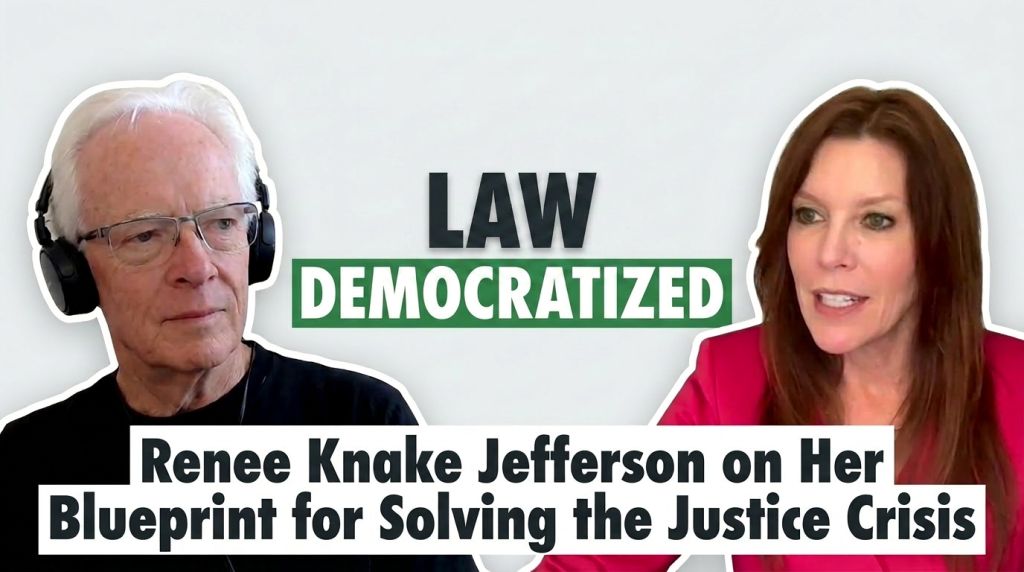
LawNext podcast features Renee Knake Jefferson discussing her 2024 book 'Law Democratized: A Blueprint for Solving the Justice Crisis.' The episode revisits her proposals two years post-publication amid growing concerns about the rule of law. The conversation centers on systemic legal-access reform rather than specific AI tools or tactics.
See moreThis arXiv paper critically analyzes tools and trust mark frameworks for operationalizing trustworthy AI, using OECD data to map asymmetries in ethical focus, lifecycle coverage, and stakeholder targeting. It finds heavy emphasis on fairness, transparency, and robustness but neglect of explainability, digital security, and environmental sustainability, with most tools concentrated on post-development stages. The authors recommend expanding ethical objectives, embedding ethics across the AI lifecycle, and fostering broader multi-stakeholder participation to bridge the principles-to-practice gap.
See more
Marginal Revolution comments on China's AI strategy of commoditizing complements, noting that Xi explicitly ties AI openness to moving from digital into physical applications. China's dominance in robotics and manufacturing stands to benefit massively from widely available AI models. The post is a brief strategic observation rather than a detailed analysis.
See more
FreightWaves' Phil Brink covers a $1 billion cargo theft network exposed by the FBI and federal crackdowns on 75 CDL training schools suspected of widespread fraud. The report details sophisticated criminal methods, implications for driver safety, and how law enforcement and brokers are responding to these supply chain security threats.
See more
YouTube has updated its monetization policies to more clearly define which AI-generated and low-quality videos are ineligible for ad revenue. The move targets AI slop and upsetting content that floods the platform. This affects creators and brands relying on YouTube for distribution and monetization.
See more
Five major US tech companies reportedly carry $1.65T in hidden debts tied to opaque AI funding arrangements. The Hacker News post body contains no substantive content beyond a comments link. The headline raises significant questions about AI capital expenditure transparency and financial risk reporting.
See more
A VentureBeat survey of 107 enterprises finds 54% have already experienced a confirmed AI agent security incident or near-miss, yet only 32% give each agent its own scoped identity and most agents share credentials. Security stacks are overwhelmingly borrowed from model providers rather than purpose-built for agents, with satisfaction high despite thin spending. A majority of enterprises plan to change tooling within the year, revealing satisfaction with controls they are simultaneously preparing to replace.
See more
Import AI issue 465 covers the narrowing gap between open and closed AI models, introduces Kimi K3, and discusses Demis Hassabis's AI policy proposals. The newsletter frames the singularity as a transitional period visible only in hindsight. Body content is minimal, suggesting the full analysis lives behind a subscription or link.
See more
Forrester's Global Sovereignty Forecast 2025-2030 challenges the assumption that technological sovereignty equates to self-sufficiency. Governments have poured billions into sovereign clouds, national AI programs, and semiconductor manufacturing, but Forrester argues this framing is detached from global interdependence realities. The forecast likely redefines sovereignty around strategic autonomy rather than full independence.
See more
A US judge has approved Anthropic's $1.5-billion settlement of a copyright lawsuit brought by authors who accused the company of misusing their books to train Claude. The settlement resolves one of the major legal challenges facing AI companies over training data practices. This sets a precedent for how copyright disputes around AI training data may be resolved.
See more
Ben Horowitz and a16z leaders discuss why American tech leadership matters globally, exploring how AI infrastructure, cybersecurity, and startup expansion shape geopolitical power. The conversation examines a16z's strategy to help founders scale internationally and the role of Western technology in government partnerships. Key themes include tech as an arena of national power and fostering trusted global partnerships.
See moreSafe-Psych is a sequential benchmark evaluating how LLMs handle evolving diagnostic uncertainty in clinical psychiatry, using over 1,000 real-world psychiatric notes with psychiatrist-derived action labels (DIAGNOSE, CLARIFY, ABSTAIN). Findings reveal that even strong models exhibit over 60% under-abstention, frequently diagnose before sufficient evidence is available, and rarely seek clarification unless explicitly prompted. Safety-aware prompting shifts errors toward excessive abstention rather than improving calibration. The benchmark is released to support LLM safety research in healthcare.
See more