Google is Paying to Build AI Agents
Google is investing heavily in AI agent infrastructure. Here is what that means for builders.
Google is investing heavily in AI agent infrastructure. Here is what that means for builders.
Free resources that teach AI better than most paid courses. Save your money.
Claude usage analytics tool breakdown — track tokens, costs, and optimize your AI spend.
MCP connector from Higgsfield enables mass ad creative generation with AI agents.


Another ChatGPT trend is here People are turning their profiles into cute crayon-style cartoons using ChatGPT. The idea is simple. Upload a screenshot of your profile, paste the prompt, and let the model redraw the whole page as if it was made with crayons on white paper. The result keeps the profile layout, but turns the details into a playful handmade version filled with sweet childlike elements. It works because the output feels personal, nostalgic, and instantly shareable. Would you try this with your own profile?

Persistent memory in AI agents creates a new attack surface where prompt injections survive across sessions and re-enter context on every retrieval. Security researcher Johann Rehberger demonstrated SPAIware writing malicious instructions into ChatGPT's long-term memory, and the MemoryGraft paper shows poisoned experience records causing durable behavioral drift in autonomous agents like MetaGPT. Three key defenses apply: scope memory per instance, validate writes for injection patterns, and maintain per-entry provenance to enable surgical removal of poisoned entries.
See more
Laguna S 2.1 from Poolside is now available on Vercel's AI Gateway in free and paid versions, offering an open-weight Mixture-of-Experts model with up to 1M token context. The model specializes in agentic coding and long-running tasks, scoring 78.5% on SWE-bench Multilingual and 70.2% on Terminal-Bench 2.1. Developers can integrate it via the AI SDK with unified API features including usage tracking, failover, and BYOK support at provider pricing with no markup.
See more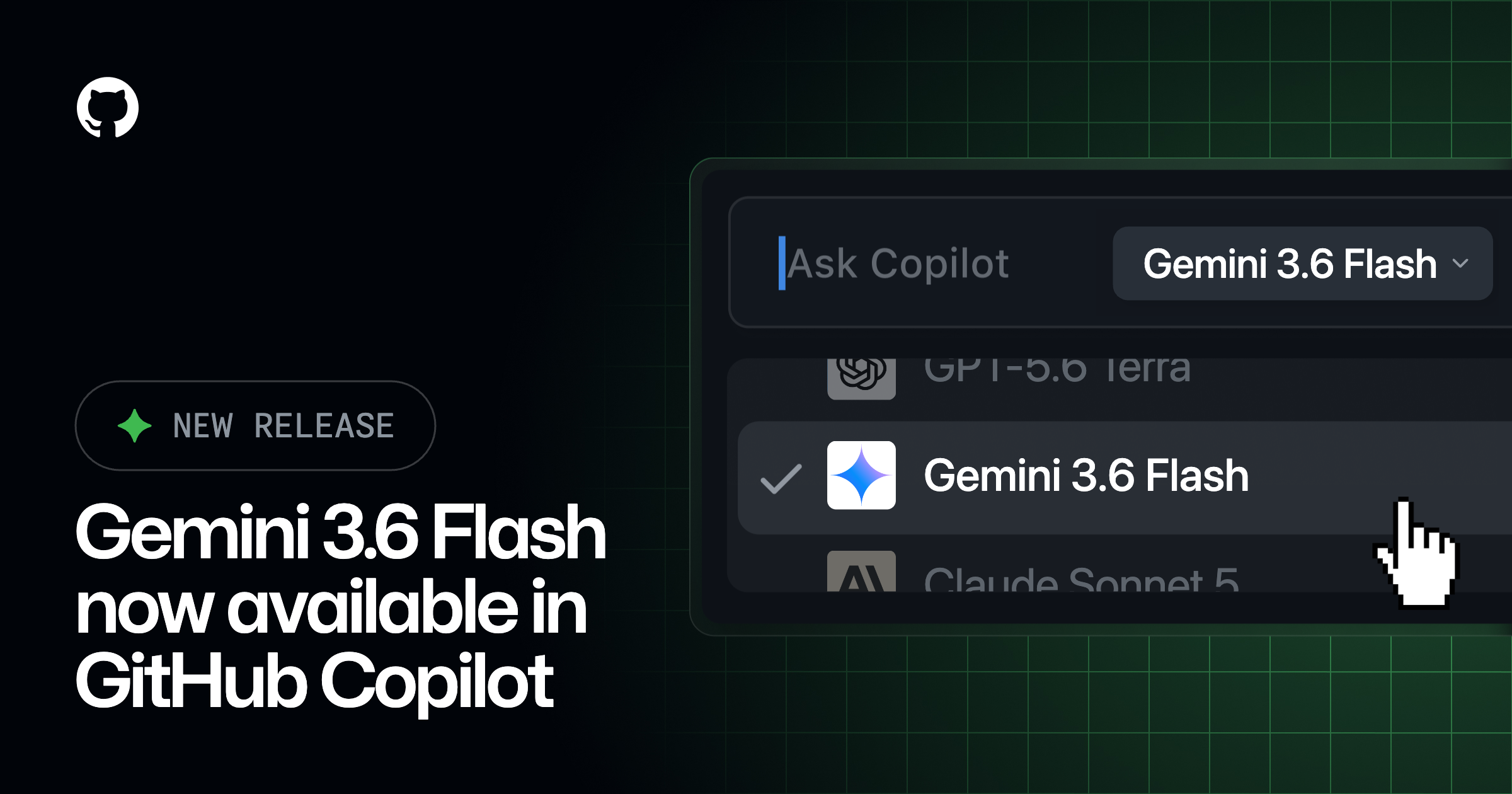
Google's Gemini 3.6 Flash model is now rolling out inside GitHub Copilot, targeting web and app development, coding, and longer-horizon agentic workflows. The model offers configurable settings for developers using Copilot. This expands Copilot's model options beyond OpenAI and Anthropic offerings.
See more
PlanFlip introduces four planning-phase prompt injection attacks against multi-agent LLM systems that corrupt downstream sub-tasks via the Planner agent. Testing nine frontier LLMs across 3,479 episodes reveals that stronger models like GPT-5 are more vulnerable (ASR=0.68), homogeneous pipelines have a correlated-agent blind spot, and reasoning-augmented models like DeepSeek-R1 resist injections. The authors propose two defenses—GoalAnchorCheck and CrossAgentConsensus—achieving detection rates up to 1.00, concluding that heterogeneous model diversity is a security prerequisite.
See more
A VentureBeat survey of 157 enterprises reveals a critical agent evaluation gap: 50% have shipped AI agents that passed internal evaluations but then failed in production, and only 5% fully trust automated evaluation today. Despite this, 66% already allow or are engineering toward zero-human-in-the-loop deployment for low-risk agents. The core problem is not evaluation coverage but reality alignment — evaluations pass agents that fail real customers, and autonomy is scaling faster than assurance.
See more"Weights to Words" is a method that automatically discovers domain-relevant preference dimensions described in natural language and paired with model vectors, enabling users to inspect and edit preference model inferences. Validated across moral dilemmas, movies, wines, and LLM responses with two pre-registered experiments (N=450, N=449), it shows that regularizing toward learned dimensions and incorporating user edits both improve prediction accuracy. Participants preferred its inferred profiles and endorsed its predictions as more accurate in head-to-head comparisons.
See more![ASCIITermDraw-Bench | Evaluating VLMs on ASCII Generation and Editing Tasks [P]](https://preview.redd.it/p8w6ju0sk5eh1.png?width=140&height=84&auto=webp&s=dc9838126b956835f1fe68d2840d3e4adbb10dcc)
ASCIITermDraw-Bench is a new benchmark evaluating Vision Language Models on their ability to generate and edit ASCII-based diagrams across 80 tasks in four categories: basic layouts, network topologies, software architecture, and image-conditioned editing. Each response is scored structurally and semantically via an LLM judge with 95% confidence intervals. The current leaderboard is led by Gemma-4-31B-IT at 73.8%, with the benchmark and methodology publicly available on Hugging Face.
See more
Airbnb engineered a Transformer-based sequence model to encode years of guest behavior—views, bookings, reviews, cancellations—replacing hundreds of hand-crafted ranking features. The system tackles three challenges: view-event dominance (97.8% of events), sparse booking signals versus noisy browsing, and computational tractability of very long sequences. The result is richer guest preference representations that improve search personalization.
See more
The Alabama State Bar released guidance on ethical AI use in legal practice, clarifying that AI recontextualizes existing professional duties rather than creating new ones. Lawyers must verify AI-generated output, as demonstrated by recent sanctions cases including Ibach v. Stewart where an attorney was sanctioned $17,000 for submitting AI-generated fictitious citations. The guidance recommends written AI-use policies, vendor diligence, data governance, and documented human review checkpoints for legal departments.
See moreOpenLanguageModel (OLM) is an MIT-licensed PyTorch library for building and pretraining small language models with transparent, readable code. It supports tokenizers, streaming datasets, mixed precision, and CPU through multi-GPU execution, with 27 presets across nine model families. Validation shows 90.6% four-GPU weak-scaling efficiency for a 348M-parameter workload and close agreement with reference implementations.
See more
Relativity's newly appointed president Chris Brown discusses the company's acquisition of Gavel and its strategic decision to integrate Claude into its product ecosystem. He highlights the rapid growth of aiR, Relativity's AI-powered review product, as a key revenue and adoption driver. The interview covers product strategy, marketing realignment, and how generative AI is reshaping the legal e-discovery market.
See more
Forrester analyst takes over coverage of the Product Information Management (PIM) space and observes that AI is rapidly transforming it beyond its traditional roots. The post reflects on vendor briefings, historical research, and the evolution of PIM systems. However, the visible body is truncated and lacks substantive detail on specific AI-driven changes or vendor assessments.
See more
A hands-on tutorial demonstrating how to fine-tune the OpenVLA robot AI model using LoRA on Google Colab. Covers dataset preparation, Colab environment setup, training metrics, and Weights & Biases logging for reproducibility. Aimed at practitioners who want a reproducible 100-step fine-tuning workflow.
See more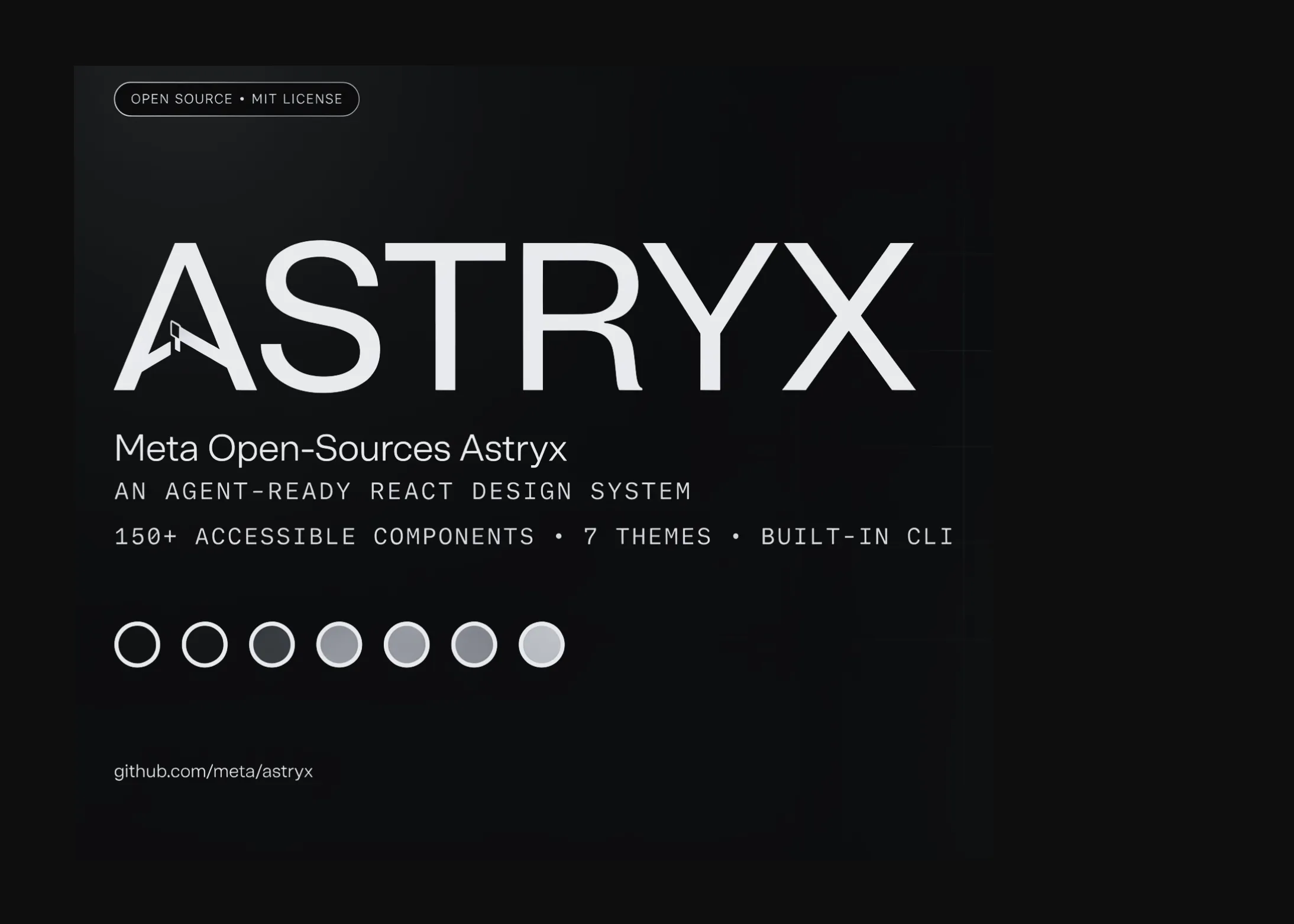
Meta has open-sourced Astryx, the React and StyleX design system used internally across 13,000+ apps for eight years. It includes 150+ accessible components, seven themes, dark mode, templates, and an agent-ready CLI under the MIT license. React 19+ is required.
See more
Google launched Gemini 3.5 Flash Cyber, a cost-efficient AI security model for finding and patching vulnerabilities, positioned as a cheaper alternative to larger models like Anthropic's Mythos. The model is available first to governments and trusted partners via CodeMender, Google's security-focused coding agent. It enables high-speed, low-cost scanning of more code paths by AI agents.
See more
Tradeshift replaced its legacy BI tool with Amazon Quick's agentic AI capabilities, achieving query response times up to 30x faster and a 40% reduction in total cost of ownership. The shift also turned embedded analytics into a revenue-generating product. The post provides a concrete case study of migrating from traditional BI to agentic AI.
See moreAlex Lieberman, founder of Morning Brew, shares a Claude-powered content workflow that interviews him before drafting, encodes his voice in Markdown, and runs a six-persona revision loop before publishing. The system is designed to produce high-quality content at scale without sounding generic or AI-generated. This is a practical playbook for creators and marketers building repeatable AI content pipelines.
See more
A TLDR newsletter roundup covering three AI-related stories: a deal between Meta and Anthropic, SpaceX providing compute infrastructure to the Pentagon, and AI-assisted code migrations. The post body was unavailable, so detailed analysis is limited. The topics span enterprise AI partnerships, defense-sector compute provisioning, and developer tooling for legacy code modernization.
See more
Google released three new Gemini models—3.6 Flash, 3.5 Flash-Lite, and Flash Cyber—expanding its portfolio of efficient and specialized AI models. However, the continued absence of Gemini 3.5 Pro raises questions about Google's flagship AI strategy and whether the company is prioritizing breadth over a top-tier reasoning model.
See more
Paytm CEO Vijay Shekhar Sharma announced plans to monetise in-house AI tools within a year, with some already generating revenue. The company is building tools for merchant acquisition, customer engagement, collections, and retention targeting both small businesses and large enterprises. This aligns with Paytm's sharpened focus on wealth services.
See more