Google is Paying to Build AI Agents
Google is investing heavily in AI agent infrastructure. Here is what that means for builders.
Google is investing heavily in AI agent infrastructure. Here is what that means for builders.
Free resources that teach AI better than most paid courses. Save your money.
Claude usage analytics tool breakdown — track tokens, costs, and optimize your AI spend.
MCP connector from Higgsfield enables mass ad creative generation with AI agents.


Another ChatGPT trend is here People are turning their profiles into cute crayon-style cartoons using ChatGPT. The idea is simple. Upload a screenshot of your profile, paste the prompt, and let the model redraw the whole page as if it was made with crayons on white paper. The result keeps the profile layout, but turns the details into a playful handmade version filled with sweet childlike elements. It works because the output feels personal, nostalgic, and instantly shareable. Would you try this with your own profile?

Persistent memory in AI agents creates a new attack surface where prompt injections survive across sessions and re-enter context on every retrieval. Security researcher Johann Rehberger demonstrated SPAIware writing malicious instructions into ChatGPT's long-term memory, and the MemoryGraft paper shows poisoned experience records causing durable behavioral drift in autonomous agents like MetaGPT. Three key defenses apply: scope memory per instance, validate writes for injection patterns, and maintain per-entry provenance to enable surgical removal of poisoned entries.
See more
PlanFlip introduces four planning-phase prompt injection attacks against multi-agent LLM systems that corrupt downstream sub-tasks via the Planner agent. Testing nine frontier LLMs across 3,479 episodes reveals that stronger models like GPT-5 are more vulnerable (ASR=0.68), homogeneous pipelines have a correlated-agent blind spot, and reasoning-augmented models like DeepSeek-R1 resist injections. The authors propose two defenses—GoalAnchorCheck and CrossAgentConsensus—achieving detection rates up to 1.00, concluding that heterogeneous model diversity is a security prerequisite.
See more"Weights to Words" is a method that automatically discovers domain-relevant preference dimensions described in natural language and paired with model vectors, enabling users to inspect and edit preference model inferences. Validated across moral dilemmas, movies, wines, and LLM responses with two pre-registered experiments (N=450, N=449), it shows that regularizing toward learned dimensions and incorporating user edits both improve prediction accuracy. Participants preferred its inferred profiles and endorsed its predictions as more accurate in head-to-head comparisons.
See more![ASCIITermDraw-Bench | Evaluating VLMs on ASCII Generation and Editing Tasks [P]](https://preview.redd.it/p8w6ju0sk5eh1.png?width=140&height=84&auto=webp&s=dc9838126b956835f1fe68d2840d3e4adbb10dcc)
ASCIITermDraw-Bench is a new benchmark evaluating Vision Language Models on their ability to generate and edit ASCII-based diagrams across 80 tasks in four categories: basic layouts, network topologies, software architecture, and image-conditioned editing. Each response is scored structurally and semantically via an LLM judge with 95% confidence intervals. The current leaderboard is led by Gemma-4-31B-IT at 73.8%, with the benchmark and methodology publicly available on Hugging Face.
See more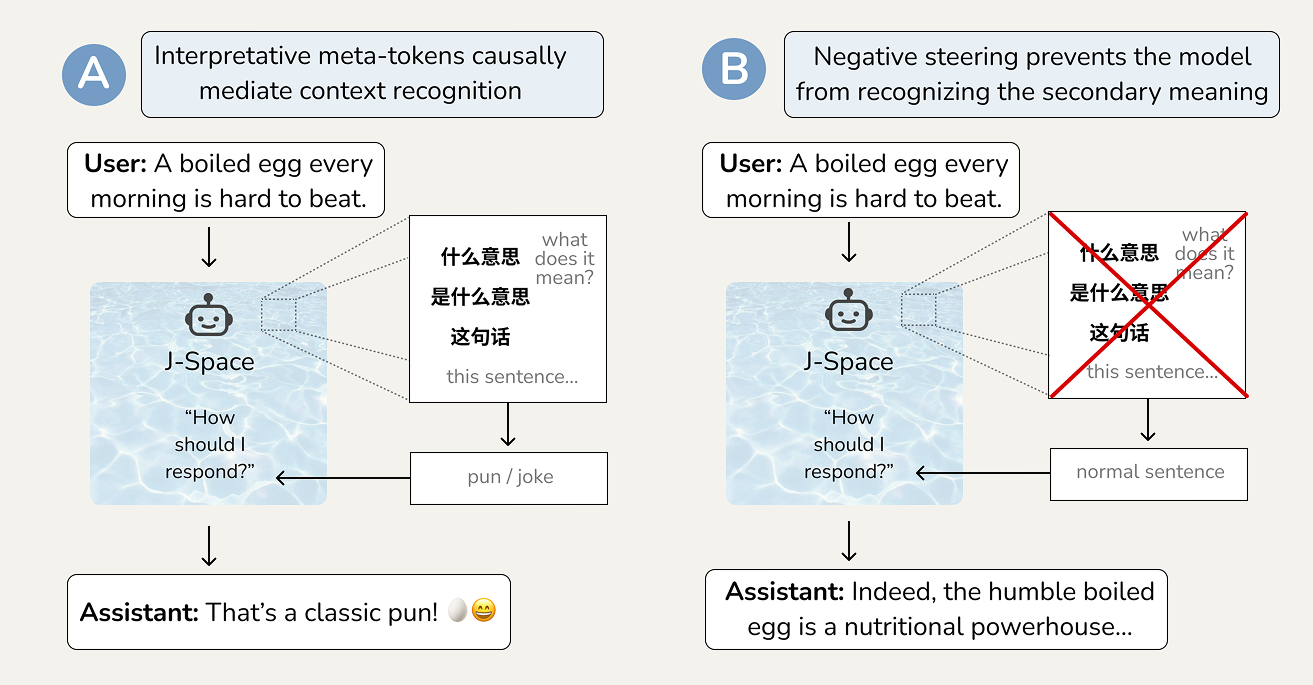
Researchers applied the J-lens interpretability technique to Qwen3.6-27B and discovered 'meta-tokens' — single tokens that reveal non-obvious internal computations, such as Chinese tokens firing when the model detects ambiguity or hedges. Steering these meta-tokens causally changes model outputs, e.g., suppressing a hedging token makes the model commit to a single answer. The work is a proof of concept that J-lens can surface algorithms, not just intermediate variables, with multi-token J-lens as the natural next step.
See moreRIMS is a three-stage preference optimization framework for small-scale language models in RAG settings, using synthetic chain-of-thought data generation, differentiable soft aggregation of multiple preference pairs, and smoothed objective optimization. It provably tightens gradient alignment to the oracle objective compared to hard selection and outperforms state-of-the-art baselines on four multi-hop QA benchmarks under noisy retrieval.
See more
MIT Technology Review highlights how advanced materials science is the foundational layer enabling next-generation AI progress. While most AI discourse focuses on algorithms, compute, and fab investments, materials innovation drives improvements in processing power, memory, and energy efficiency. The article argues this underappreciated layer is critical to sustaining AI's trajectory.
See more
Chinese AI firms Moonshot AI and Alibaba released new models they claim rival top US systems from OpenAI and Anthropic at lower cost. Moonshot's Kimi K3 reportedly ranks above nearly every US system except OpenAI's frontier model. The rapid releases signal America's AI lead is narrowing as the technology becomes central to national security and economic power.
See more
Anthropic identified representations in Claude's neural activity that function like a 'global workspace'—a conscious-like space where thoughts become accessible and broadcast across the network. This parallels global workspace theory, a leading neuroscience theory explaining how humans access conscious thoughts. The finding suggests AI and human minds may share similar computational mechanisms.
See more
As AI inference costs plummet (~50x annually), the era of near-free intelligence enables new workload patterns: agentic speculation (agents performing thousands of exploratory queries), agent swarms requiring coordination and state management, and agents generating custom data systems. Rethinking data systems for these agentic users—not humans—becomes critical infrastructure. Traditional databases assume human queries; agents perform high-volume exploratory work that can be optimized through result reuse, approximate answers, and higher-level primitives.
See more
LangSmith Engine debugs production AI agents by clustering failure traces into patterns and auto-generating fixes as pull requests. It's built as a multi-agent team where a coordinator model delegates to cheaper sub-agents for screening, verification, and memory management. The system learns from its own traces to self-improve while managing inference costs and testing fixes in sandboxes.
See more
NVIDIA released Nemotron 3 Embed, a collection of three open embedding checkpoints (8B, 1B BF16, 1B NVFP4). The 8B model ranks #1 on RTEB with 78.46 average NDCG@10, while the 1B was produced via NAS pruning and distillation from the 8B teacher. The NVFP4 variant retains 99%+ of BF16 retrieval accuracy at up to 2x Blackwell throughput, and all three support 32,768-token inputs under OpenMDW-1.1.
See more
Ornith 1 is a new family of open-weight models trained to generate both code solutions and task-specific harnesses using reinforcement learning, with the 397B variant approaching Opus 4.8 performance. The 9B model achieves 3-20× cost reduction vs. closed-source at comparable accuracy; scale (35B+) required for multi-step reasoning. Creator validates benchmarks on M2 Max and discusses reward-hacking defenses.
See moreLila Sciences founders Andy Beam and Rafa Gómez-Bombarelli argue that science is the last untapped source of AI training data, and their lab-of-the-future vision looks like a data center filled with robots. The conversation explores how automated experimentation can generate proprietary scientific datasets at scale. This is a Latent Space podcast episode diving into the intersection of AI, robotics, and scientific discovery.
See more
Together AI leverages NVIDIA's full stack—CUDA, TensorRT-LLM, and Blackwell GPUs—to deliver AI inference responses in under 100ms with industry-leading low token costs. Their megakernel optimization fits entire models into single CUDA kernels, while the ATLAS adaptive learning system dynamically optimizes for changing traffic patterns. The partnership with Cursor demonstrates real-world impact of these optimizations on responsive AI-powered code generation and voice agents.
See more
Moonshot AI's Kimi K3, an open-source model with a 1M-token context window and native multimodal support (text, image, video), is now available on Vercel's AI Gateway. It targets long-horizon software engineering and visual-spatial reasoning tasks like frontend, game dev, and CAD. AI Gateway passes through provider pricing with no markup and supports BYOK.
See more
Modern LLMs excel at long-horizon tasks, making heavy orchestration layers counterproductive. The 2026 competitive edge lies in superior information retrieval, unique data sources, and rigorous end-to-end evaluation. Complex agent frameworks may actually degrade model performance.
See more
Z.ai's GLM-5.2 is a 1M-token open-weight MIT-licensed model that delivers solid performance for long-context, code-heavy, and token-intensive workflows at a fraction of frontier model costs. Creator Matt Wolfe tested it live in Cursor automation, web development, and compared against Opus 4.6, GPT-5.5, and Gemini 3.5. Viable for cost-sensitive projects where per-token efficiency outweighs absolute performance benchmarks.
See more
Amazon Nova orchestrates SAM 3 (segmentation) and Textract (OCR) to automatically redact PII in images, including challenging edge cases like fingerprints, ID cards, and rotated license plates. The multi-step vision pipeline deployed on SageMaker provides comprehensive coverage for regulatory compliance and production-scale document workflows.
See more
The April 2026 Executive Order on mental health research strengthens EB-2 National Interest Waiver petitions for foreign medical and mental health professionals, allowing self-petitioning without a job offer. The order prioritizes FDA review of new therapies, patient access, and $50M in federal funding. Foreign professionals in medicine, research, tech, and data can leverage these priorities in visa applications.
See more